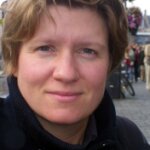
INTERVIEW WITH ROSALINDE VAN DER VLIES (ENGLISH)
Deputy Head of the Cabinet of European Commissioner for the Environment Janez Potočnik
During the European Green Week (3 to 5 June) all spotlights are on the circular economy. Plan C co-hosts a satellite event and takes part in a side event of the Green Week. At TEDx Flanders, Janez Potočnik, the European Commissioner for the Environment, gave an inspiring speech on the potential of the shift towards a circular economy. We had an interview with Rosalinde van der Vlies, Deputy Head of the Cabinet of Potočnik.
The circular economy is the central theme of this year’s European Green Week. Why is a circular economy important for Europe?
Rosalinde Van der Vlies: “We live in a resource-intensive economy that was shaped in an era when resources were plentiful and could be used cheaply, or for free. This model led to degradation of our natural capital and climate change, exposing the limits of the planet. At the same time, the global economy is expected to go on growing, and by 2030 three billion more people will have joined the middle class. With growing global demand, many resource prices have been increasing fast over the last decade, reversing the downward trend observed in the 20th century.
The reality is that global competition for green markets is getting more intense, and we can’t afford to be left behind.
These global mega-trends will shape the future. For an innovation and technology optimist, they show that a new, green growth model is bound to emerge. The EU has to be prepared to turn the challenges of this resource revolution into opportunities.
The reality is that global competition for green markets is getting more intense, and we can’t afford to be left behind. This is another reason why resource efficiency is so important for Europe. It is a way forward that will not only help us create a strong economy for the long term but also offers concrete solutions to exit from the current crisis – and this time, in a sustainable way.”
How can we kick-start that sustainable transformation?
Van der Vlies: “We need better policies to make that happen. Getting away from today’s linear model – where we mine, manufacture, use and throw away – is a must if we are to move to a resource-efficient economy and society.
Incremental efficiency improvements will not be enough.
Incremental efficiency improvements of production processes are important and make a lot of business sense, but they will not be enough to create more wealth, while reducing the pressure on natural resources. We need to repair, re manufacture, re use and recycle, facilitating the new business models that underpin such economic organisation, and ultimately eliminating waste.”
Not everybody is pleased with the emergence of a circular economy. Many companies thrive or survive due to a linear consumption-model. How does Europe deal with these diverse interests?
Van der Vlies: “It is clear that our current way of producing and consuming is not sustainable in the long term. It only way of future growth is green growth. But longer term thinking sometimes requires moving away from short-term gains. Many companies have understood this and have invested in resource-efficient business models. Companies are increasingly using environmental performance to differentiate themselves and their products on the market. The global number of sustainability reports per year increased from almost zero in 1992 to about 4000 reports in 2010; and the estimated number of environmental labels worldwide is more than 400.
Numerous studies confirm that using our resources in a more efficient way makes economic common sense.
Numerous studies confirm that using our resources in a more efficient way makes economic common sense. Every percentage point reduction in resource use from the EU is worth around € 23 billion to business and could result in 100 000 to 200 000 new jobs (gws-study, pdf). But it is clear that change is never easy and that we need to support companies in this transition.
How are stakeholders involved in the EU policies on resource efficiency?
The EU should at least double its resource productivity.
The need to work hand in hand with business led commissioner Potočnik to set up the European Resource Efficiency Platform (EREP) a couple of years ago. EREP counts among its members business leaders, representatives from NGOs and civil society.
In 2012 the Platform issued a Manifesto calling for a circular, resource-efficient and resilient economy. Since then it has published two further sets of policy recommendations that aim to inspire new policies, on re use and recycling for example, but also voluntary business actions such as pilots to measure environmental footprints of products, financial reporting that takes into account resource efficiency, etcetera.
Commissioner Potočnik intends to put forward a Circular economy package this Summer.
Recently EREP has recommended that the EU should at least double its resource productivity, equivalent to an increase of well over 30%, by 2030. Resource productivity is measured by GDP relative to raw material consumption. By linking the economic and environmental agenda, resource productivity represents an important step in the context of measuring societal progress beyond GDP.
Many of these recommendations are now being addressed and will be further developed in the Circular economy package that commissioner Potočnik intends to put forward this Summer.”
Can you give an example of a ‘circular business case’ that appeals to you?
Van der Vlies: “There are many examples, it’s difficult to pick only one. Very recently the European Commission has announced the winners of this year’s European Eco-Management and Audit Scheme (EMAS) Awards. The theme of 2014 was circular economy. It was a real pleasure to see the levels of creativity, excellence and engagement shown by the entries.”
With thanks to Janneke van Veen (OVAM).